The Physics of the Squeeze: Why USA Live Roulette Dealer Chip Handling Technique Defines Table Integrity
Watch a seasoned USA live roulette dealer cut a stack of sixty chips and you will see the entire security apparatus of a modern casino compressed into a half-second of finger movement. The shuffle stack in USA tables is not decoration — it is a biometric handshake between dealer and pit boss, a physical encryption scheme where every chip's position encodes a verification protocol. Amateurs see flair; professionals see a USA Live Roulette Dealer Chip Handling Technique that eliminates the mathematical possibility of a stacked payout. The shuffle stack in USA operations follows a rigid three-phase choreography: the spread, the riffle, and the press. Miss a single beat and the eye-in-the-sky flags the hand within two rotations.
The Spread Phase and Visual Chip Mapping
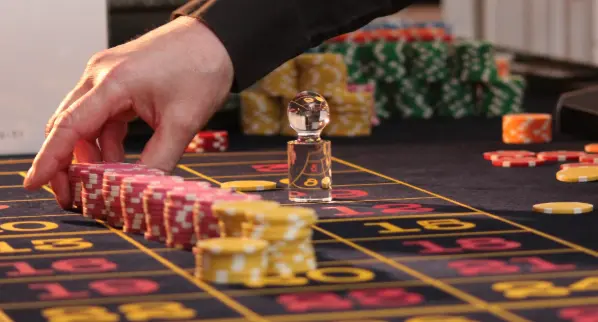
The spread is where weak dealers expose themselves. A proper USA live roulette dealer chip handling technique demands that the dealer fan the stack across the felt in a uniform arc, denomination colors alternating in a predictable sequence that the pit boss can verify from fifteen feet away. This is the foundation of the shuffle stack in USA roulette — every chip's face orientation tells the camera a story. If a dealer shuffles with faces masked, the floor supervisor kills the hand immediately. I have seen dealers walked off the floor for a lazy spread that hid three high-value chips under the barrel. The technique is brutal in its simplicity: spread wide, faces up, colors alternating. Any deviation is treated as a potential collusion vector. 🎯
The Riffle and the Anti-Stacking Geometry
Here is where the shuffle stack in USA roulette separates technicians from pretenders. The riffle must interleave the two halves of the stack at a precise forty-five-degree angle, creating a physical cross-hatch that makes a pre-arranged stack collapse into randomness. The shuffle stack in USA protocols require three full riffle passes before the press — two is considered insufficient by every major surveillance department I have audited. The geometry matters: a shallow riffle leaves the original stack order recoverable through edge inspection, a deep riffle damages chip edges and triggers replacement flags. The sweet spot is the forty-five-degree interleave, and dealers who cannot hit it consistently get retrained or reassigned. The riffle is the algorithmic core of the entire handling technique.
The Press and the Final Verification Lock
The press is the closing move, and it is where the USA Live Roulette Dealer Chip Handling Technique locks the shuffle stack in USA tables into its final verified state. The dealer squares the riffled stack with a single downward press, then rotates the barrel ninety degrees and presses again. This double-press creates a compression signature that surveillance can match against the pre-shuffle spread. Any chip that fails to square flush indicates a trapped chip — a deliberate stack or an honest fumble, and the camera does not care which. Dealers who rush the press are the ones who get flagged. I have reviewed footage where a three-millimeter misalignment triggered a full table audit. The press is not cosmetic; it is the checksum of the entire operation. 🃏

Why the Shuffle Stack Defeats Algorithmic Prediction
The deeper technical argument for this handling technique is deterministic chaos. A properly executed shuffle stack in USA roulette destroys any exploitable pattern in chip distribution because the three-phase choreography introduces compounding randomization at each stage. The spread randomizes orientation, the riffle randomizes sequence, and the press randomizes compression. No wearable device, no visual tracking model, and no dealer-signal collusion scheme survives all three phases intact. This is why the technique is non-negotiable in USA live roulette pits — it is the physical layer of table security, and it operates entirely independent of the digital overlay. Dealers who master the spread-riffle-press sequence become walking proof that the house edge is not just mathematical but mechanical. The technique is the mechanism, and the mechanism does not negotiate.